
Buy Noise Buds for FREE | I Get FREE Internet
We have all heard the famous financial advice:
“Don’t put all your eggs in one basket.”
Almost every financial advisor will tell you not to concentrate all your money in one place. And there is a very good reason for that. If you put all your savings or investments into one asset, one company, one stock or one investment category, you are taking concentration risk. If that particular investment performs badly, a large portion of your wealth could be affected. That is why diversification is an important principle when it comes to saving and investing money. But here is an interesting thought: What if the opposite approach makes sense when it comes to spending?
When you are already going to spend money, especially through credit cards, cashback cards and reward-point cards, concentrating your eligible spending on one rewards card can sometimes help you accumulate rewards faster. I’m not saying you should literally use only one credit card for everything. I’m saying that if you have a card with a particularly useful cashback or reward structure for your normal spending, it can make sense to make that card your primary spending card and concentrate eligible expenses on it.
The key is simple: Don’t spend more to earn rewards. Make the spending you were already going to do work harder for you.
Saving and Spending Are Two Different Games
The “don’t put all your eggs in one basket” rule makes a lot of sense when we’re talking about wealth and investments.
Suppose you have ₹5 lakh to invest. Putting the entire ₹5 lakh into one risky investment means that the performance of that single investment can have a huge impact on your finances. That’s why people diversify.
You might have money in:
- Savings accounts
- Fixed deposits
- Mutual funds
- Stocks
- Bonds
- Gold
- Other investments
The objective is to avoid excessive concentration risk. But spending works differently.
Suppose you already spend ₹50,000–₹60,000 every month on things such as groceries, online shopping, subscriptions, bills, travel and other regular expenses. The money is going to be spent anyway.
So the question becomes:
Why spread that spending across several payment methods if one suitable card can give you better rewards for those eligible transactions?
That’s where concentrating your spending can make sense.

Turn Reward Points Into Something You Actually Want

Here’s another way I look at it. Suppose this Noise Alt Clip Wireless Open-Earbuds (2026) costs ₹ 3,999 . I don’t necessarily need to buy them immediately. Instead, I can continue using my rewards card for eligible expenses that I was already going to make. For example my Credit Card gives me to convert 1000 reward points into Flipkart Gift Voucher/ Over time, the reward points accumulate. Eventually, if the card’s redemption options provide a suitable ₹3, 999 voucher or equivalent value, I can use that redemption toward the earbuds.
The mental calculation becomes: Regular spending → Reward points → Gift voucher → Earbuds
It feels like the earbuds were paid for by the rewards generated from previous spending. Technically, they aren’t completely free—you had to spend money to generate the rewards. But if the original spending was necessary anyway, you’re effectively converting a benefit from that spending into something you wanted to buy. That’s a much better way to think about credit card rewards.
Amazon and Flipkart Gift Cards
This strategy can become particularly useful when your credit card’s reward programme allows you to redeem points for shopping vouchers. For example, some credit-card reward programmes offer vouchers or gift cards for popular shopping platforms.
You may accumulate points over several months and then convert them into a shopping voucher when you actually need something. The exact number of points required depends on the particular card, voucher and current redemption catalogue. So don’t assume that a particular number of points always equals a particular rupee value. Always check the current redemption value before redeeming.
The One-Card Spending Strategy
Imagine you have five credit cards. You might have:
- Card A – Cashback
- Card B – Reward points
- Card C – Travel rewards
- Card D – Shopping rewards
- Card E – Another cashback card
If you randomly use all five cards, your rewards can become scattered. For example:
Card A: ₹300 cashback
Card B: 1,500 points
Card C: 800 points
Card D: ₹250 cashback
Card E: 1,000 points
You’ve earned rewards, but they’re fragmented across multiple accounts. Now imagine that one card gives you particularly useful rewards for the majority of your regular spending. Instead of randomly switching between cards, you make it your primary spending card. Your eligible spending gets concentrated. Your rewards accumulate faster. And instead of having small amounts scattered everywhere, you eventually have a meaningful balance that you can actually redeem.
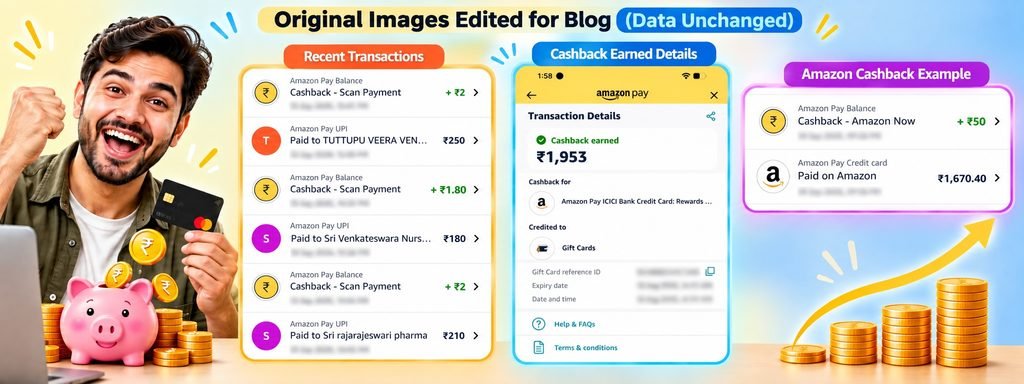
My Internet Bill Example
This is where I personally find the strategy interesting. Suppose my monthly internet bill is around ₹1,000. I already have to pay this bill every month. Now suppose I use my Amazon Pay ICICI Bank Credit Card for my regular eligible spending. Depending on the type of transactions and the current cashback rules, some Amazon purchases can earn higher cashback.
Let’s say my normal spending generates around ₹900–₹1,000 in cashback during the month. That cashback gets credited according to the card’s monthly billing/statement cycle. And here is where the cycle becomes interesting.
I then use the same Amazon Pay ICICI credit card to pay my ₹1,000 internet bill. If that particular internet-bill transaction is eligible for cashback under the current card terms, I earn cashback on that transaction as well.
So the cycle becomes: Regular spending → Cashback accumulates → Cashback gets credited → Pay internet bill using the same card → Earn applicable cashback → Continue spending → Next cashback cycle
In other words, I have some of my cashback sitting there, and instead of letting it remain unused, I use it to offset one of my regular expenses. For example, suppose I accumulated ₹950 cashback. My internet bill is approximately ₹1,000. I can use that accumulated cashback to effectively offset most of that expense, depending on how the cashback is credited and redeemed under the card’s terms. Then I again pay the internet bill using the same card. If the transaction is eligible, that payment itself generates additional cashback, which becomes part of the next cycle. So I’m not looking at cashback as a one-time discount. I’m looking at it as a continuous rewards cycle.
The important point I am not spending ₹20,000 just to get ₹1,000 cashback. I’m spending money on things I was already going to buy. The cashback is simply a benefit I receive for using the appropriate payment method. And that distinction is extremely important.
Cashback is only one side of the equation. Reward points can also become powerful when you accumulate them over time. Let’s say you regularly use a particular credit card and accumulate points. Instead of immediately redeeming a small number of points, you can allow them to build up. For example:
Month 1: 2,000 points
Month 2: 2,500 points
Month 3: 3,000 points
Month 4: 2,500 points
Month 5: 3,000 points
You now have: 13,000 points
Depending on the credit card and its current redemption catalogue, those points may be redeemable for shopping vouchers, products, travel benefits or other options. The important thing to remember is that the value of a reward point isn’t necessarily ₹1. Different cards can have different redemption values. So always check the current redemption rate before deciding what your points are worth.
Why Concentrating Spending Can Be Useful
There are three major advantages.
1. Faster Reward Accumulation
If you put ₹60,000 of eligible monthly spending on one card instead of distributing it across several cards, you may reach useful redemption thresholds faster.
Instead of having: 2,000 points + 1,000 points + 1,500 points across different cards, you might have: 4,500 points in one rewards programme. That can make redemption much easier.
2. Easier Tracking
Multiple credit cards can become complicated and also as you have all expenses in one place it’s easy to check which expenses to control.
You have to remember:
- Which card gives cashback?
- Which card gives reward points?
- Which card has category-based rewards?
- Which card has reward caps?
- Which card has minimum redemption requirements?
- Which card has points that expire?
- Which transactions are excluded?
Using one primary rewards card for most eligible expenses simplifies the process. You still keep other cards for situations where they provide a specific advantage or as backups.
3. Rewards Become Meaningful
₹100 cashback may not feel exciting. Neither does ₹200. But when those small amounts accumulate: ₹500 → ₹1,000 → ₹2,000 → ₹5,000 they become much more useful. You can potentially use them for:
- Shopping vouchers
- Travel
- Household expenses
- Subscriptions
- Online purchases
- Other eligible redemptions
The important thing is to let rewards accumulate without allowing them to encourage unnecessary spending.
Multiple Credit Cards Are Still Useful
This strategy doesn’t mean you should cancel all your other credit cards. Multiple cards can have different advantages. For example:
Card 1: Primary everyday spending
Card 2: Travel
Card 3: Fuel
Card 4: Specific shopping offers
Card 5: Backup
The idea is to identify the card that gives you the most useful effective reward for your regular spending and make that your primary card. If another card provides a substantially better reward for a particular purchase, use it. So this isn’t really:
“Use only one credit card.”
It is:
“Concentrate your spending strategically.”
Don’t Spend More Just to Earn Cashback
This is probably the most important rule of this entire strategy. Suppose you don’t need a ₹10,000 product. But your credit card offers 5% cashback. You buy it anyway because you want ₹500 cashback. That’s not saving money. You spent ₹10,000 to get ₹500 back. The better approach is: Need it? Buy it.
Already going to spend? Use the payment method that gives you the appropriate reward.
Never reverse that logic. Don’t allow cashback to become an excuse for unnecessary spending.
The Golden Rule: Never Pay Interest to Earn Rewards
This rule is more important than every cashback percentage mentioned in this article. Never pay ₹100 in credit-card interest to earn ₹1 in cashback. Credit-card rewards are useful only when you manage your credit responsibly. If you carry a revolving balance and pay interest, the interest can easily outweigh the rewards you earned. The ideal cycle is:
Spend → Earn rewards → Receive cashback/points → Pay the credit-card bill in full → Redeem rewards
Not:
Spend → Earn rewards → Carry balance → Pay interest
If you’re carrying expensive credit-card debt, maximizing reward points should not be your priority.
Concentrate Spending. Diversify Savings.
And this brings us back to the title. The traditional advice is: Don’t put all your eggs in one basket.
When it comes to saving and investing, that’s often a useful principle because diversification can reduce concentration risk.
But when it comes to spending, there can be a different strategy. If you already have several expenses every month, and one credit card gives you a particularly useful cashback or reward structure for those eligible transactions, concentrating more of your spending on that card can help you accumulate rewards faster.
So my simple rule is:
For savings: Diversify. Don’t put all your eggs in one basket.
For spending: Concentrate strategically. Put all your eggs in one basket.
Don’t spend more simply because you get cashback. Don’t carry credit-card debt to collect points. Don’t assume every transaction earns rewards. And don’t blindly use one card when another card offers a genuinely better benefit. Instead:
Spend what you were already planning to spend. Use the right rewards card. Let the cashback and points accumulate. Pay your credit-card bill in full. Redeem the rewards for things you actually need or want.
Maybe it’s your internet bill. Maybe it’s groceries. Maybe it’s an Amazon or Flipkart gift card. Maybe it’s a pair of earbuds. Maybe it’s a flight ticket. Over a year, those small rewards can add up to a surprisingly meaningful amount. Your spending is happening anyway.